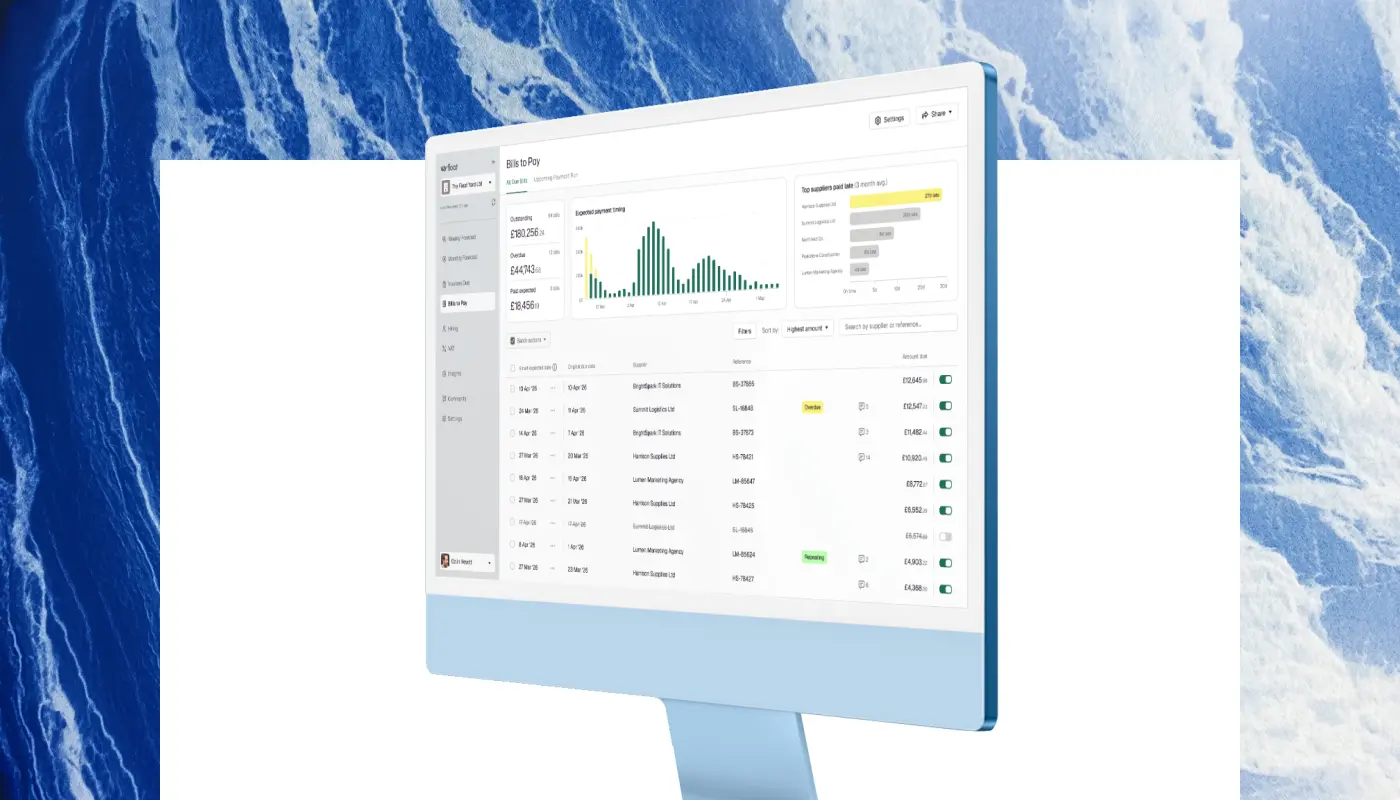

Improving cash flow visibility comes down to four moves: consolidate your cash position across every bank account and entity, automate the data flow from your accounting platform, run a rolling 13-week cash flow forecast, and review it weekly with clear ownership. This guide walks through each step, and shows where spreadsheets stop being the right tool for the job.
What cash flow visibility actually means
Cash flow visibility has two halves, and finance teams need both.
The first is your current cash position: where the cash is right now, across every account, entity and currency. A bank balance on its own is not a cash position. Some of that money may belong to a different entity, sit in a different currency, or already be committed to Friday's payroll. A useful current view shows reconciled balances by account and entity, when the data was last refreshed, and what is genuinely available rather than merely present.
The second is the forward view: where the cash will be over the coming weeks. This is your cash flow forecast, built from expected customer receipts, supplier payments, payroll, tax and any planned one-offs. The Association of Corporate Treasurers describes the short-term operational forecast as generally covering a rolling 13 weeks, and ICAEW recommends the same rolling 13-week structure for growing businesses that need close control of liquidity.
A simple way to hold the distinction: your accounts tell you what happened. Visibility tells you what needs action now, and what is coming.
The cost of poor cash flow visibility
The reason visibility matters is that receipts rarely arrive when the invoice says they will, and the consequences of finding that out late are well documented.
In the UK, government-commissioned research by London Economics for the Department for Business and Trade and the Office of the Small Business Commissioner (2025) estimates that £26 billion is owed in late payments at any given time, that around 14,000 businesses close each year as a result, and that affected businesses spend an average of 86 hours a year chasing what they are owed. In the US, the Federal Reserve Banks' 2025 report on employer firms found 51% cited uneven cash flow, including collecting receivables, as a financial challenge. In Australia, the Payment Times Reporting Regulator's latest data shows only 66.5% of small-business invoices were paid on time, and the time taken to pay the slowest invoices is getting worse, not better. ASIC's insolvency data adds the sharpest edge: inadequate cash flow or high cash use was nominated in 52% of external administrators' reports for 2022–23.
None of this means software prevents failure. What it means is that payment timing is unreliable enough that a finance team forecasting from invoice due dates alone will be wrong in a consistent direction, and a team that cannot see its lowest point of headroom early makes every decision later and with fewer options.
How to improve cash flow visibility: six steps
Step 1: Consolidate your current cash position. Bring every bank account and every entity into one view, in one reporting currency, with intercompany transfers identified so nothing is counted twice. If your consolidated position lives in a spreadsheet that requires logging into three bank portals to update, this step alone is probably where most of your reporting time goes.
Step 2: Automate the data flow from your accounting platform. Your accounting system already holds reconciled balances, open invoices and unpaid bills. Connecting your cash flow tool directly to Xero or QuickBooks Online removes the export-and-retype cycle and means the forecast starts from figures the ledger already agrees with.
Step 3: Build a rolling 13-week cash flow forecast. Thirteen weeks covers roughly a quarter of payroll, supplier, tax and debt cycles while staying close enough for line-level assumptions. Each week, the completed week drops off and a new week is added, so the horizon never shrinks. We cover the full build in our guide to implementing a 13-week cash flow forecast.
Step 4: Set a weekly cadence with one owner. The pattern that works for finance teams of three to six people: the Finance Manager or Controller owns and refreshes the forecast, contributors confirm receipts and payment timings, and the FD or CFO challenges the assumptions and owns escalation. Separating preparation from review matters more than letting everyone edit. If you are building this rhythm from scratch, start with our guide to implementing cash flow forecasting in your finance team.
Step 5: Work from one shared, controlled view. One current forecast, visible to everyone who needs it, with editing rights limited to the people maintaining it and a visible timestamp for the last data refresh. Comments belong attached to the number they explain, not scattered across email threads that have to be reconstructed at review time.
Step 6: Compare forecast with actuals every week. Variance review is how the forecast gets better. If receipts consistently land later than assumed, the forecast should learn that, and the collection conversation should start earlier. Record the reason for each material variance and assign the action to a named person.
Where spreadsheets break down: multiple banks and entities
A spreadsheet can hold a cash forecast. What it struggles to hold is a cash forecast fed by several banks and more than one entity, updated weekly, by more than one person.
Multi-bank reporting means aligning data that differs by institution: refresh timing, balance definitions, statement formats, currencies. The bigger risk than arithmetic error is coverage error: an account or a transaction simply missing from the view. Multi-entity reporting adds a second layer: cash held by one entity is not freely available to another, intercompany transfers appear as an outflow in one ledger and an inflow in another, and each entity's spreadsheet drifts on its own version and cut-off time. The group can have enough total cash while one entity cannot make payroll without a transfer nobody has scheduled.
The academic evidence on spreadsheet risk points the same way. Raymond Panko's field-audit research found errors in the large majority of operational spreadsheets audited, and the deeper finding is that even low cell-level error rates compound as formulas, links, versions and repeated weekly updates accumulate. The answer is not that spreadsheets are careless. It is that a weekly, multi-entity, multi-contributor cash process needs controls that spreadsheets only provide if someone builds and polices them by hand.
Do you need real-time liquidity visibility?
Ask an AI assistant about real-time liquidity visibility and you will mostly hear about enterprise treasury platforms: Kyriba, HighRadius and their peers. These are genuine real-time systems, and it is worth being precise about what that means and who they are for.
A treasury management system connects directly to banks and can receive intraday balance feeds through bank APIs and SWIFT messaging, alongside payments, FX and debt management. It is built for organisations with a dedicated treasury function, many banking relationships and material currency or interest-rate exposure. Pricing is quote-based, and implementation is a project in its own right, with connectivity, configuration, testing and training typically measured in months.
An accounting-integrated tool works differently. It syncs from the ledger your team already runs, so its data is as current as the last reconciliation and sync. Float, for example, syncs with your accounting platform every 24 hours, or on demand, pulling the latest reconciled balances, invoices and bills. That is current-on-sync visibility of figures your ledger agrees with. It is not an intraday bank feed, and we would rather say so plainly than stretch the phrase "real-time".
Which one you need is a question about complexity, not headcount. If your team runs treasury operations across many banks and currencies with a dedicated treasurer, a TMS is the right category. If your team is 3 to 6 people inside a company of 11 to 50 staff, running Xero, QuickBooks Online or Sage Intacct, and the job is a trusted weekly view of consolidated cash and a rolling forecast, an accounting-integrated tool does that job at the data speed those decisions run at, without the implementation project.
Cash flow visibility is a team discipline
The collaboration failure in cash reporting is nearly always a version failure: two people edit separate copies, leadership receives numbers produced before the latest payment run, and the Monday meeting opens with a debate about whose figure is right.
The fix is structural. One live forecast everyone reads. Editing rights for the people who maintain it, viewing rights for the people who consume it. Comments attached to the specific receipt or payment they explain. A visible record of when the data last refreshed. These are the controls that let a finance team stand behind one number, and they are the difference between collaboration and co-editing. We go deeper on how finance teams work in Float on our finance teams page.
How Float fits
Float is a cash flow forecasting and visibility layer for exactly this working pattern. It connects to Xero and QuickBooks Online, with Sage Intacct on the waitlist, and syncs every 24 hours or on demand, pulling the latest reconciled bank balances, invoices and bills into one consolidated view. On top of that position it maintains rolling forecasts in daily, weekly and monthly views, scenario planning to test timing risks before they land, and budgets against actuals so variance review is built into the weekly rhythm rather than bolted on. Role-based permissions keep editing rights with the forecast owner while giving leadership a live, read-only view of the same numbers.
Frequently asked questions
What is cash flow visibility?
Cash flow visibility is a finance team's ability to see a trusted current cash position across all accounts and entities, plus a credible forward view of where cash will be over the coming weeks. It combines consolidated, reconciled balances with a rolling forecast, at the level of detail and frequency the team's decisions need.
What is the difference between cash position and cash flow forecasting?
Your cash position is a point-in-time view of where cash sits now, across accounts, entities and currencies. A cash flow forecast is the forward view: expected receipts and payments projected over coming weeks to show future headroom. Good visibility connects the two, using the reconciled current position as the starting point for the forecast.
How do I get better cash visibility for business planning?
Consolidate all accounts and entities into one view, automate the data feed from your accounting platform, maintain a rolling 13-week forecast, and review it weekly against actuals. For planning decisions such as hiring or investment, pair the 13-week operational view with a longer monthly forecast so short-term liquidity and longer-term plans stay connected.
Which tools give real-time liquidity visibility?
True intraday liquidity visibility comes from bank-connected treasury platforms such as Kyriba or HighRadius, which receive balance feeds through bank APIs and are built for dedicated treasury functions. Accounting-integrated tools such as Float provide current-on-sync visibility of reconciled figures from Xero or QuickBooks Online, refreshed daily or on demand, which is the fit for weekly liquidity decisions in smaller finance teams.
Does a small finance team need a treasury management system?
Usually not. A TMS earns its cost where there is a dedicated treasury function, many banking relationships, material FX exposure or intraday payment operations. A finance team of 3 to 6 people managing consolidated cash and a rolling forecast is normally better served by a tool that integrates with the accounting platform it already runs, at a fraction of the implementation effort.
How often should a finance team review cash flow?
Weekly is the working standard: refresh the data, roll the 13-week forecast forward, update receipt and payment timings, review variances against last week's forecast and assign actions. Check balances daily only when headroom is tight or a large payment run is due, and reconcile the operational view with the longer-range budget monthly.
How do you consolidate cash across multiple entities?
Bring each entity's reconciled balances into one view with a common reporting currency, identify intercompany transfers so they are not double-counted, and keep entity-level drill-down so you can see both group cash and what each entity can actually access. The key discipline is distinguishing consolidated cash from locally available cash, because a healthy group total can hide an entity that cannot cover its own payroll.
How do finance teams collaborate on a cash flow forecast?
The workable pattern is one shared live forecast with separated roles: an owner who maintains it, contributors who confirm timings in their area, and leadership with read-only access to the same view. Comments sit against the specific numbers they explain, and a visible refresh timestamp tells everyone how current the data is, which removes the version debates that spreadsheet-based reporting invites.
Can you improve cash flow visibility without leaving spreadsheets?
To a point. A single-entity business with one or two accounts can run a controlled 13-week spreadsheet forecast if it enforces version control, access rules and a weekly update discipline by hand. The case for a dedicated tool builds as banks, entities, currencies and contributors are added, because each one multiplies the consolidation work and the opportunities for version drift.
How does Float keep cash flow data secure?
Float connects through the authorised integrations of your accounting platform rather than asking for bank credentials, and role-based permissions control who can edit the forecast and who can only view it. That separation lets a finance team share live visibility with leadership without opening up editing access to the underlying model.
How much does cash flow visibility software cost?
Accounting-integrated tools are priced as monthly subscriptions, and enterprise treasury platforms are quote-based with separate implementation costs. Float's current plans and a free trial are on our pricing page.
If your cash position currently lives across bank portals and a spreadsheet that only one person understands, the fastest way to test the alternative is with your own numbers. Start a free trial and Float will build your consolidated view and first rolling forecast directly from your Xero or QuickBooks Online data.